 Refrigeration and heat pump systems are designed to move heat in a controlled way—either to provide cooling (refrigeration) or to deliver useful heat (heat pumps). The core engineering challenge is to achieve the required cooling capacity or heating output with the lowest possible energy consumption, while meeting real-world constraints such as variable operating conditions, temperature levels, part-load behavior, and increasingly strict efficiency and environmental requirements.
High performance is achieved by selecting the optimum process concept (cycle layout, pressure levels, staging, economizers, intercooling, subcooling, heat recovery) and by integrating the system effectively with its surroundings—heat sources, heat sinks, and adjacent processes. In many projects, the biggest gains come from system integration: matching temperature levels, minimizing temperature approaches in heat exchangers, recovering waste heat, and optimizing operating strategies across seasonal and load variations.
Vapor compression processes
A vapor compression process (vapor-compression refrigeration / heat pump cycle) is the dominant industrial method for producing cooling (refrigeration/chillers) or useful heat (heat pumps). It works by circulating a refrigerant in a closed loop and forcing heat to flow “uphill” in temperature by using mechanical work (usually from an electric motor driving a compressor).
Absorption refrigeration processes
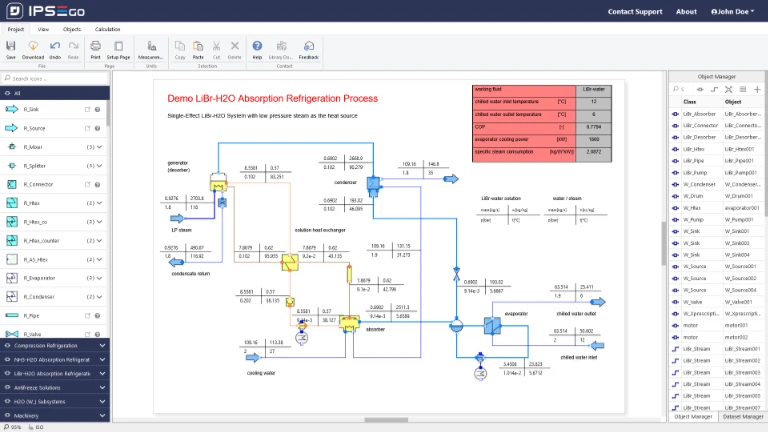
An absorption refrigeration process produces cooling without a mechanical compressor. Instead, it uses thermal energy (steam, hot water, waste heat, or a burner) to provide the equivalent of compression: refrigerant vapor is absorbed into an absorbent at low pressure, the resulting solution is pumped to a higher pressure, and the refrigerant is then desorbed (separated) in a generator using heat. The working medium is a pair of substances (refrigerant + absorbent). Two common pairs are:
- Water / Lithium Bromide (H₂O/LiBr): water is the refrigerant, LiBr is the absorbent.
- Ammonia / Water (NH₃/H₂O): ammonia is the refrigerant, water is the absorbent.
Performance evaluation of heatpumps, refrigeration and cooling systems
IPSE supports the modelling and performance evaluation of a wide range of refrigeration and heat pump configurations, including:
- Industrial refrigeration (food and beverage, cold storage, process cooling)
- District heating and large heat pumps (waste heat recovery, sewage water, geothermal, ambient sources)
- Chillers and cooling plants (building services, data centers)
- Cascade systems and multi-stage compression
- Heat recovery and combined heating/cooling systems (simultaneous heating and cooling demand)
- Heat and mass balance software for refrigeration cycles
A reliable heat and mass balance model (also referred to as a mass and energy balance) is a key factor for successful refrigeration and heat pump projects. In early project phases, engineers need to confirm feasibility: target temperatures, required capacity, achievable COP/EER, compressor operating limits, and heat exchanger duties. During detailed design and operation, models are used to:
- Predict COP / EER and energy consumption under varying boundary conditions
- Evaluate part-load performance and control strategies
- Size and validate compressors, heat exchangers, evaporators, condensers, and auxiliary equipment
- Identify pinch points and integration opportunities with other processes
- Compare alternative layouts and quantify the benefit of heat recovery and process coupling
IPSE for refrigeration and heat pump modelling
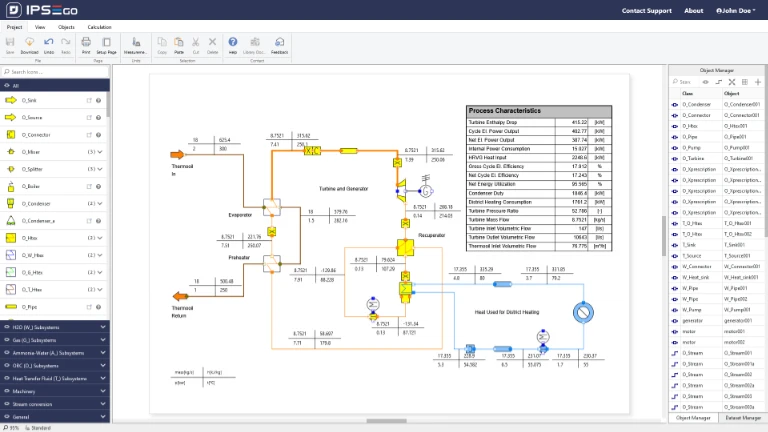
IPSE models provide valuable information for selecting and designing efficient refrigeration and heat pump processes. With its flexible, equation-based approach, IPSEpro enables users to create consistent cycle performance models and plant-wide energy balances—from the refrigeration loop itself to the surrounding heat source and heat sink systems. This supports engineering decisions from concept development through commissioning and optimization, helping teams reduce energy use, improve integration with adjacent processes, and achieve robust performance over the full operating range.