 Shortage of fresh water has become one of the major challenges for societies all over the world. Water desalination offers an opportunity to significantly increase the freshwater supply for drinking, industrial use and irrigation. Over the last decades seawater desalination has become an important source for potable water for many arid regions.
RO - Reverse Osmosis
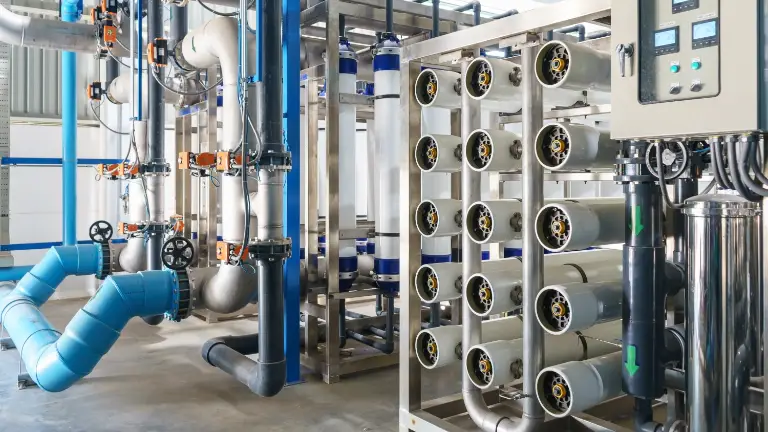
Reverse osmosis (RO) desalination is a pressure-driven separation process used for both seawater and brackish water. The feedwater is pumped to a pressure above its osmotic pressure and passed across a semi-permeable RO membrane that allows water to permeate while retaining most dissolved salts and other solutes. The process produces a low-salinity product stream (permeate) and a separate high-salinity reject stream (concentrate or brine).
MSF - Multi-Stage Flash
MED - Multi-Effect Distillation
MED (Multi-Effect Distillation) desalination is a thermal desalination process that produces fresh water by evaporating seawater in a series of vessels (“effects”) operated at progressively lower pressures and temperatures; vapor generated in each effect condenses to provide the heating duty for the next effect, so the same latent heat is reused multiple times to drive successive evaporation, while the condensate is collected as distillate and the remaining liquid becomes progressively more concentrated brine.
MVC - Mechanical Vapor Compression
MVC (Mechanical Vapor Compression) desalination is a thermal desalination process that produces fresh water by evaporating seawater and then mechanically compressing the generated vapor to raise its pressure and saturation temperature, so that when the vapor condenses it releases enough latent heat to drive further evaporation of the feed in a closed heat-pump-like loop; the condensate is collected as distillate and the remaining liquid is discharged as concentrated brine.
TVC - Thermal Vapor Compression
Performance Models
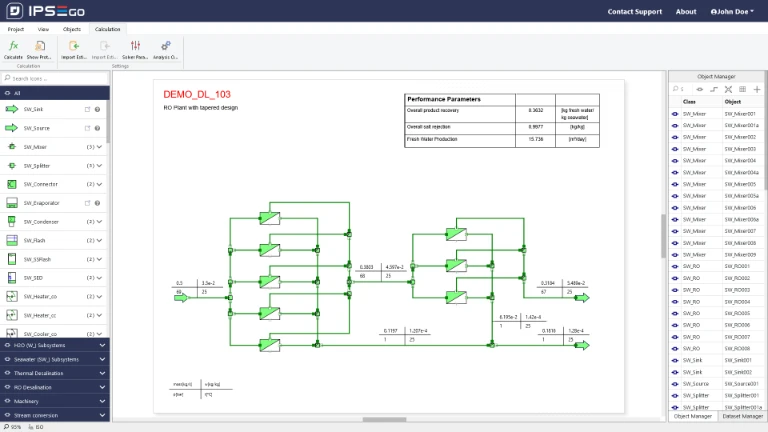
To guarantee affortable supply of water through desalination the demand for the construction of efficent and economic desalination plants is growing continuously. Reliable performance models are essential for developing efficient plants. IPSEpro is the ideal tool for creating performance models and for using them to design efficient plants.